
European Partnership on accelerating farming systems transition through agroecology Living Labs and Research Infrastructures.
Funders : Horizon Europe
The global challenges for agriculture and food systems include problems with food security, food distribution, climate change, biodiversity loss, generational renewal and food sovereignty at regional, national and European level, and they need new approaches and responses. One identified pathway and alternative to conventional agriculture has been identified in the last years with agroecology, which can support a transition for so that farming systems are resilient, productive and prosperous, place-sensitive, as well as climate, environment-ecosystem, biodiversity and people-friendly. More concretely this should include:
- A thriving agricultural sector, which is economically viable, attractive to young generations and well connected to society.
- New as well as improved farming practices, products and services that contribute to positive ecological, climate and environmental impacts of agri-food systems.
- The strengthening of social capital, values, networks, skills and awareness on agroecology
Goals of the partnerhsip
The AGROECOLOGY Partnership aims to support an agriculture sector that is fit to meet the targets and challenges of climate change, biodiversity loss, food security and sovereignty, and the environment, while ensuring a profitable and attractive activity for farmers. The Partnership in particular pools the resources of the EC (European Commission) and the members states involved to fund high-level research generating appropriate knowledge and technologies aligned with the core themes described below.
The Partnership will contribute to filling existing knowledge gaps on agroecology, promoting more open innovation and user-driven research, addressing the wide geographical/territorial specificities in the EU through place-based approaches with long-term perspectives, and improving the sharing of knowledge within and across EU countries and beyond.
The partnership further aims to coordinate efforts, pool resources, and facilitate the transition to agroecology, envisioning resilient, productive, and prosperous farming systems that are environmentally sustainable, climate-friendly, and people-centric by 2050.
The partnership is organized around 4 core themes:
1: Redesigning agroecosystems
Supporting the transition to agroecology involves facilitating changes in practices to foster resilient and sustainable ecosystems, including landscape agroecology, territorial planning, decision support tools for farmers, and analyzing social aspects pertinent to the transition.
2: Redesigning agroecology value chains
Integrating agricultural practices with value chain perspectives entails enhancing traceability of products while also developing and assessing tailored business model.
3: Agroecology Living labs and Research Infrastructures as instruments enhancing multi-actor involvement for AE transition and the acceleration of creation and adoption of innovations
Assessing the individual and collective impact of Agroecology Living Labs and Research Infrastructures, while identifying incentives to drive engagement in the acceleration of agroecology transition.
4: Enablers of agroecology transition
Developing decision-support tools for risk assessment, policy-making, and landscape planning facilitates the identification of incentives while enhancing coherence between agricultural, environmental, and other sectoral policies.
The Agroecology partner programme has a very strong potential to put agroecology high on the European agenda to strengthen our agricultural and food systems, and having strong impact at national and European level.
Materials and methods
The project includes different work packages. ISARA is the coordinator of WP10 on Education and Training which involves many partners form different European countries. It includes higher education, secondary higher and lower-level education, training with farmers and farm advisors as well as establishing networks at European level for knowledge exchange and reinforced cooperation of stakeholders. ISARA is also involved in four others WP (See figure 1 below): WP2, WP3, WP5 and WP7.
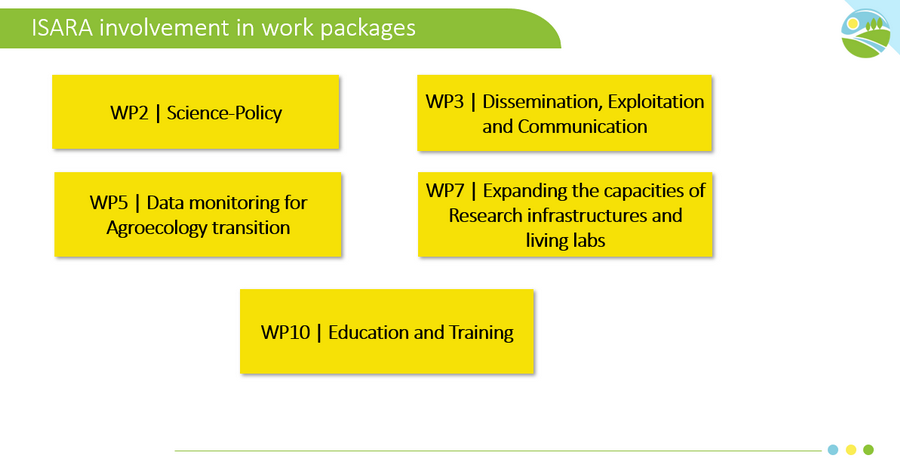
Involvement of ISARA in selected work packages of the Agroecology Partnership
Main results
Some first results of the work on Education and Training (WP10).
- A first European network in agroecology for higher education was launched in October 2026, coordinated by ISARA.
- Brochure on Career paths after a European Master’s in Agroecology (PDF)
ISARA project team
Alexander Wezel, Aurelie Ferrer, Cecile Chanel Bellet, Audrey Vincent, Ioanna Mouratiadou, Baptiste Grard, Helene Brives, Laura Solaroli.
Project partners
111 partners across 31 Member States, Associated Countries, and Third Countries.